So, you have decided to transfer your apartment to a family member, divide inherited assets, or settle property rights without going through a lengthy dispute. One of the most important documents you may come across in such situations is a settlement deed. It provides a legal record of how property is being transferred or settled between the parties and can help prevent disagreements in the future.
But what exactly does a settlement deed mean? Who can execute one? Is registration compulsory? How much does settlement deed registration cost in Kerala?
In this blog, we cover the meaning of a settlement deed, the process involved, registration requirements, and important rules in Kerala. Understanding these details can help property owners prepare the deed correctly, complete the registration process, and avoid common issues along the way.
What is a Settlement Deed?
A settlement deed is a legal document through which an apartment owner, known as the settlor, transfers or settles their apartment in favor of another person, known as the beneficiary. Unlike a sale deed, the transfer does not normally involve the payment of a sale consideration.
Settlement deeds are commonly used for transfers within families, such as when parents transfer property to their children, family members settle inherited property, or parties resolve disputes regarding property ownership. The arrangement generally takes effect during the lifetime of the parties once the deed is properly executed and registered.
When is a Settlement Deed Used?
A settlement deed can be useful in several property-related situations. Common examples include:
- Transferring property from parents to children
- Settling inherited or ancestral property among family members
- Resolving disagreements between family members over property
- Transferring property between co-owners as part of an agreed settlement
- Recording an agreed distribution of family assets
The exact type of document required depends on the ownership structure and purpose of the transaction. A settlement deed should not be treated as interchangeable with a gift deed, partition deed, release deed, or will.
What Should a Settlement Deed Contain?
A properly drafted settlement deed should clearly identify the parties, the property, and the terms of the settlement. Important details generally include the full names and addresses of the parties, their relationship, a complete property description, a survey number, the extent and boundaries, existing title details, and the rights being transferred.
The deed should also state the purpose of the settlement, possession details, and any conditions attached to the transfer. Signatures of the relevant parties and witnesses are required. Accurate property details are particularly important because unclear descriptions can create ownership disputes later.
How to Register a Settlement Deed in Kerala
The settlement deed registration process in Kerala involves the following steps:
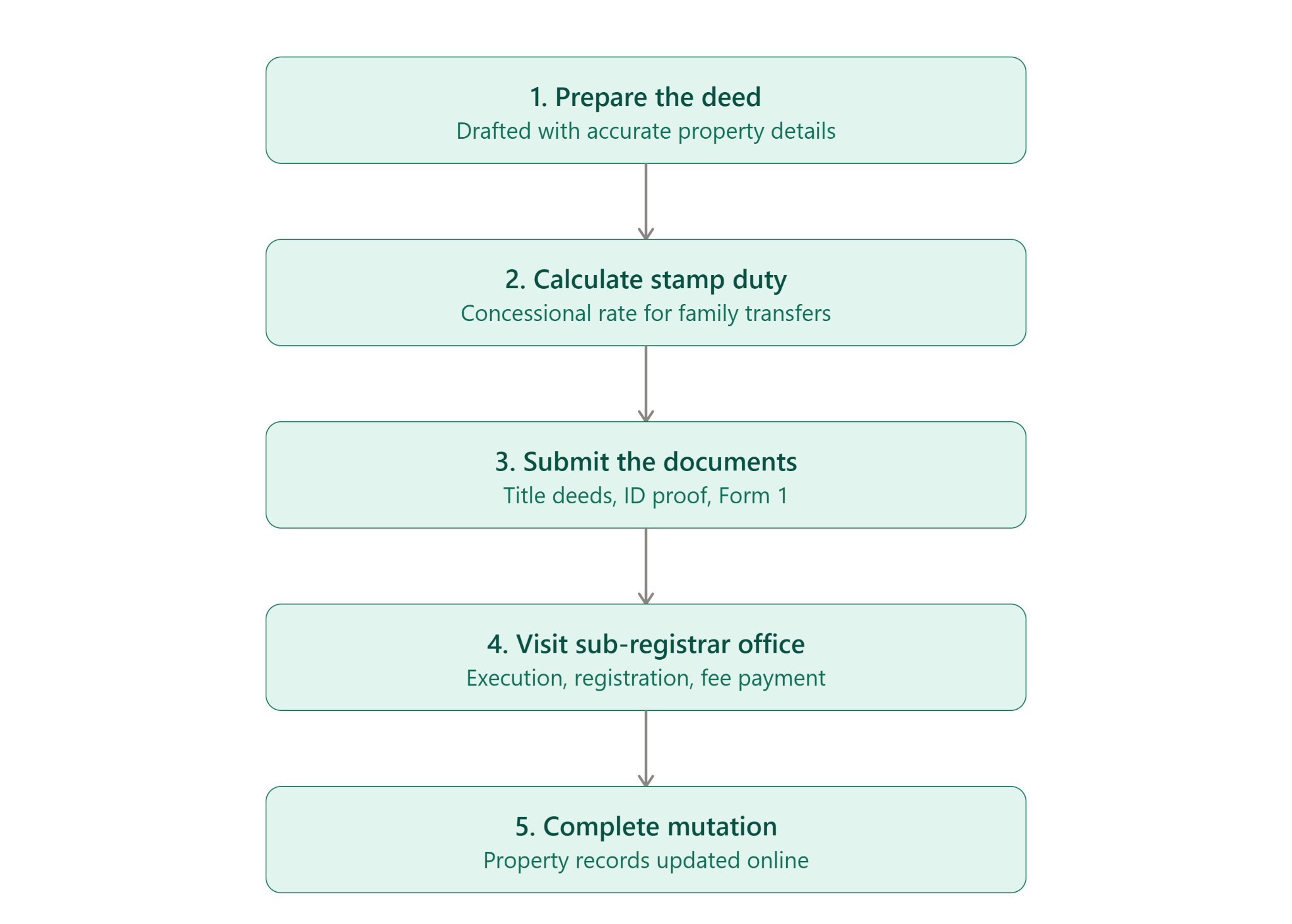
1. Prepare the Deed
The deed should be drafted with the correct details of the property and parties. You can have it prepared by a qualified advocate, licensed document writer, or the executant or claimant in accordance with the applicable requirements of the Registration Department.
2. Calculate Stamp Duty
Stamp duty must be paid according to the nature of the settlement and the relationship between the parties. Kerala provides a concessional rate for settlements in favor of family members and legal heirs.
3. Submit the Documents
The required documents, including the original or copies of previous title deeds, identity proof, and other prescribed documents, must be submitted for registration. Kerala's Registration Department also requires documents such as the relevant filing sheet, mutation application, and Form 1 in applicable property transactions.
4. Visit the Sub-Registrar Office.
The parties must appear before the concerned sub-registrar for execution and registration, subject to applicable rules regarding authorized representatives. The registration fee can be paid through the prescribed electronic payment facilities at the Sub-Registrar Office.
5. Complete Mutation
After registration, the property records should be updated through mutation or transfer of the registry. Kerala's registration process provides for forwarding the mutation application to the Revenue Department online through the Sub-Registrar.
Buying an apartment/property in Kerala involves more than just picking the right home—it means verifying the right legal documents. From title deeds to encumbrance certificates, this detailed checklist walks you through everything you need to check before signing on the dotted line
Read more →
Settlement Deed Stamp Duty and Registration Charges in Kerala
The cost of a settlement deed in Kerala depends on who receives the property and the nature of the settlement. According to Kerala's published stamp duty and fee ready reckoner, a settlement in favor of a family member or legal heir of a deceased family member attracts a stamp duty of 0.2% of the applicable value, subject to a minimum of ₹1,000. The registration fee is 1% of the fair value or market value, whichever is higher. For settlements in other cases, the stamp duty is listed at 5%, with a 2% registration fee.
Since government fees and applicable rules can change, it is advisable to verify the current amount with the Kerala Registration Department or the concerned Sub-Registrar before executing the deed.
Settlement Deed vs. Will and Gift Deed
A settlement deed is different from both a will and a gift deed. A will generally takes effect after the death of the person making it, whereas a settlement deed takes effect during the settlor's lifetime after the required execution and registration.
A gift deed also transfers property voluntarily without a sale consideration, but it serves a different legal purpose. A settlement deed is commonly used for planned family arrangements and property settlements, while a gift deed is generally used for voluntarily gifting property to another person.
A partition deed, on the other hand, is generally concerned with dividing jointly owned property among co-owners. Choosing the correct document is important because the legal consequences and applicable charges can differ.
Can a Settlement Deed Be Cancelled?
Cancelling a registered settlement deed is not always straightforward. A deed may be challenged in situations involving fraud, coercion, undue influence, lack of legal capacity, improper execution, or questions regarding the settlor's ownership.
Where the deed contains a valid revocation condition and the specified circumstances arise, cancellation may also be possible. However, once the property has been transferred and the beneficiary has acted on the settlement, legal intervention may be required.
Important Points to Check Before Registration
Before registering a settlement deed in Kerala, verify the following:
- The settlor has clear legal ownership of the property.
- The property's survey number, extent, and boundaries are accurate.
- Previous title deeds are available for verification.
- The parties are legally competent to execute the deed.
- The applicable stamp duty and registration fee have been calculated correctly.
- All required documents and identity proofs are available.
- The terms of the settlement are clearly written.
- Mutation is completed after registration.
The Kerala Registration Department also provides an official settlement deed template and document registration guidance for applicants.
Get Legal Advice Before Executing a Settlement Deed
A settlement deed can make property transfers within a family much clearer, but even a small error in ownership details, property description, or legal terms can create complications later. Before signing, it is advisable to have the deed reviewed by a qualified property lawyer and verify the applicable charges with the Sub-Registrar Office.
Understanding the settlement deed meaning, registration process, and rules in Kerala beforehand can help property owners make informed decisions and avoid unnecessary legal complications.
Desai Homes: Your Trusted Choice for Apartment Buying in Kerala
Understanding the legal and documentation aspects of property ownership is an important part of making a secure real estate decision. At Desai Homes, we believe that transparency in documentation, approvals, and property transactions are just as important as the quality of the homes we build. With decades of experience in residential development across Kerala, our team supports buyers with the necessary information and assistance throughout the property purchase process.
Are you buying a new apartment? Reviewing the property documents? Or seeking clarity on registration-related matters? Having the right guidance can make the process much easier. If you are exploring apartments in Kerala, contact us at Desai Homes to learn more about our residential projects across the state.


















































68dbd66ac38f8.png)



68c28cb77959f.jpeg)


68a6c076727fa.png)



















6788c47422946.png)












66f11bd587613.webp)
66ed22557cc38.jpg)
66ed231a7becc.jpg)
66ab7230980da.png)
6486af5e1d535.jpg)
6486ae4739e3a.jpg)
64806c2935221.jpg)
6486abb314505.jpg)